
Are MBTA Upgrades Actually Improving the T Experience?
How effective have MBTA upgrades actually been?
Introduction
It’s Saturday morning. You need to meet a friend at BU in twenty minutes. After shoving a leftover bagel into your mouth and rushing into the MBTA station en route to Park Street, you’re greeted with an unpleasant sight: “the Green Line D branch is closed due to maintenance.”
So instead of seeing your friend on time, you board a shuttle bus and slowly chug your way over to Boston, turning your trip from twenty minutes into nearly an hour long. That’s the third time this month, you think to yourself as you finally get off the shuttle.
In addition to its notorious safety issues, which include a collapsing ceiling in the Harvard station, the MBTA is beginning to be defined by what feels like constantly out-of-service trains and random delays. Most of these closures are attributed to maintenance and construction—beginning in November 2023 and ending in December 2024, the MBTA’s Track Improvement Program (TIP) sought to decrease delays and closures by removing speed restrictions and upgrading the system’s infrastructure.
In general, the MBTA appears to be in a spending crisis, with costs rising 15% from 2023 to 2024. In the FY 2025 budget, the MassDOT and MBTA boards of directors allocated at least $85 million to TIP in the FY 2025 budget, allocating $600 million in total. Two months ago, the Healey administration dedicated another $1.3 billion to upgrading to T.
Due to TIP and other infrastructural upgrades, station closures in the MBTA system have grown substantially.
 Figure 1: Station closures (including pre-planned ones) from May 2023 to the January 2026.
While ensuring available public transportation is key to a functional city, all these station closures and spending increases beg the question: how effective are these projects? Do they really result in a better T experience?
Which areas were the most affected by disruptions?
(An interactive map of MBTA closures from November 2023 to the end of 2025. To access, simply download the html file and open it.)
The T is comprised of five main lines and more than 150 stations. From November 2023 to the end of 2025 (including pre-scheduled closures), 127 stations experienced or will experience temporary closures.
 Figure 2: MBTA closures by station from November 2023 to December 2024.
North Station, on the intersection of the Orange and Green Lines, had the most closures at 24, followed by JFK/UMass, Back Bay, and Boston College. The Harvard station, on the Red Line, had just 6 closures.
How effective was TIP?
TIP was an extensive operation—over the course of the project, 12,973 ties were replaced, 250,000+ feet of rail were replaced, and Red Line Braintree branch speeds were increased, according to the MBTA. But did these changes manifest in a better experience for T riders? One way to measure this is how prediction accuracy of train arrivals changed after TIP. A predicted arrival time is considered accurate if the actual arrival falls within a certain time interval of the predicted arrival.
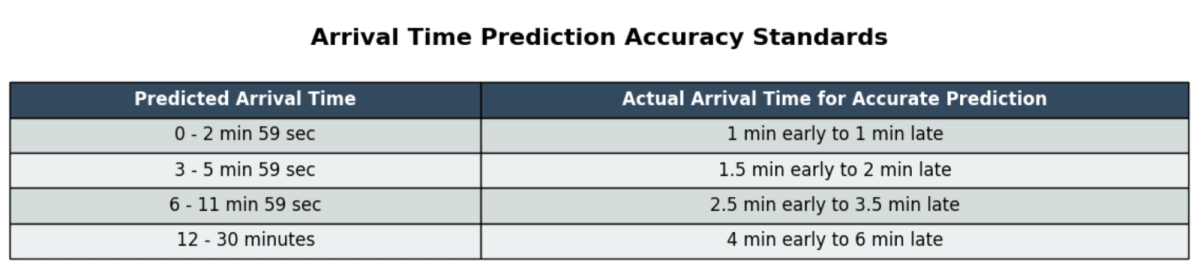 Figure 3: The arrival time interval required for a prediction to be considered "accurate."
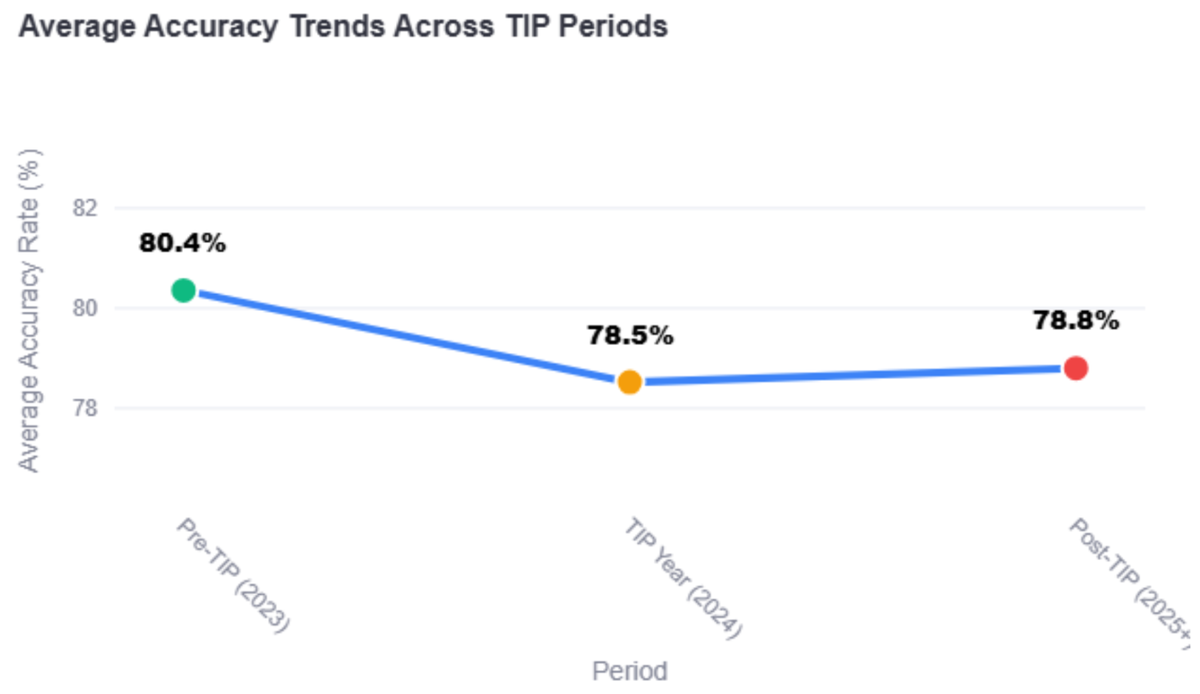 Figure 4: Average prediction accuracy over time.
TIP appeared to have a minimal impact on the average accuracy of train time predictions. Before TIP, the average accuracy was 80.4%, dropping during TIP construction, and then rising slightly to 78.8%. Since the MBTA’s prediction accuracy is 1.6% less than pre-TIP, the prediction accuracy seems to be unaffected (or even slightly negatively affected) by TIP.
Another way to assess TIP’s effectiveness is the change in speed restrictions—defined by the MBTA as “an area in which trains are required to run at slower-than-normal speeds.” Speed restrictions generally occur due to issues with tracks.
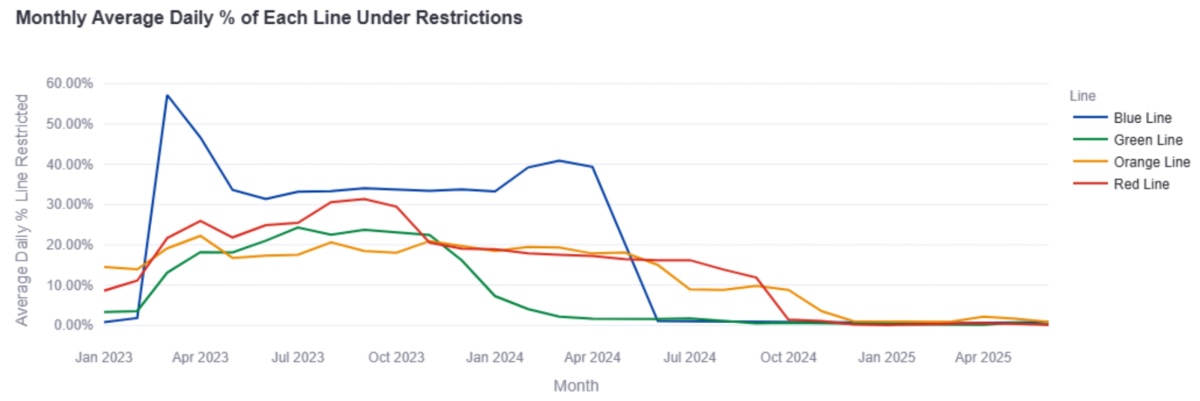 Figure 5: The percent of the MBTA system under speed restrictions broken down by T line (Silver Line omitted due to incomplete data).
Prior to TIP, the Blue Line was most severely impacted by speed restrictions by proportion, although it is worth noting that it is one of the shortest lines. The Red, Green, and Orange Lines had lower levels of restrictions by percentage compared to the blue line, though since 2025, the percentage under restrictions of all of the train lines has dropped to near-zero, suggesting that TIP played a significant role in ending restrictions across the entire MBTA system. The Silver Line was not included in this analysis because of incomplete data.
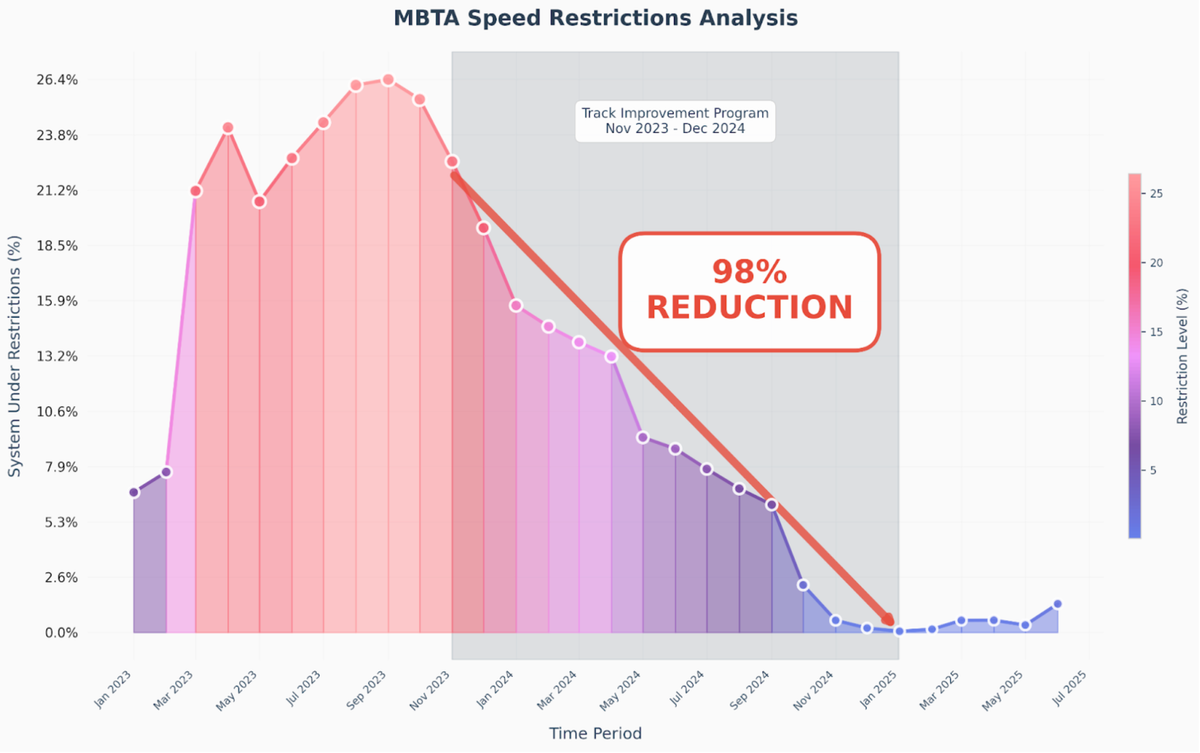 Figure 6: The percent of the entire MBTA system under speed restrictions over time.
As much as 25% of the MBTA system was under speed restrictions before the implementation of TIP in November 2023. Since TIP ended in December 2024, the percentage of the MBTA system impacted by restrictions has dropped substantially.
The 98% reduction in speed restrictions in the MBTA suggests that TIP upgrades did have a significant effect in allowing trains to go faster.
Conclusion
Broadly, TIP appears to have significantly reduced train speed restrictions, with minimal improvements to the unpredictability of train arrivals. For a more comprehensive view of the impact of TIP on the T experience, future analysis should also consider whether travel times, not just unpredictability and closures, overall decreased.
The Healey administration continues to increase investment in MBTA projects. MBTA upgrades have certainly had some positive effects—but whether they are really making the T experience better is for Massachusetts residents to decide.