

Income, Education, Race, and Psychological Disorders
For this blog post, I wanted to analyze how the factors of years of education, race, and reported psychological disorders affected median household income. There is much ongoing debate about whether a college degree is worth it and whether or not race and reported psychological disorders diminish the value of one’s education.
Introduction:
For this blog post, I wanted to analyze how the factors of years of education, race, and reported psychological disorders affected median household income. There is much ongoing debate about whether a college degree is worth it and whether or not race and reported psychological disorders diminish the value of one’s education.
Data:
The data for this analysis comes from a Health and Retirement Survey conducted by the University of Michigan, with many different variables relevant to respondents’ health and predicted age of retirement. Within this dataset, the variables that I decided to analyze are median household income, years of education (from 1–17, with 1 indicating 1st grade, 2 indicating 2nd grade, and so on), race (Black or White), and self-reported psychological diagnoses (yes or no).
Median Household Income by Years of Education (2018)
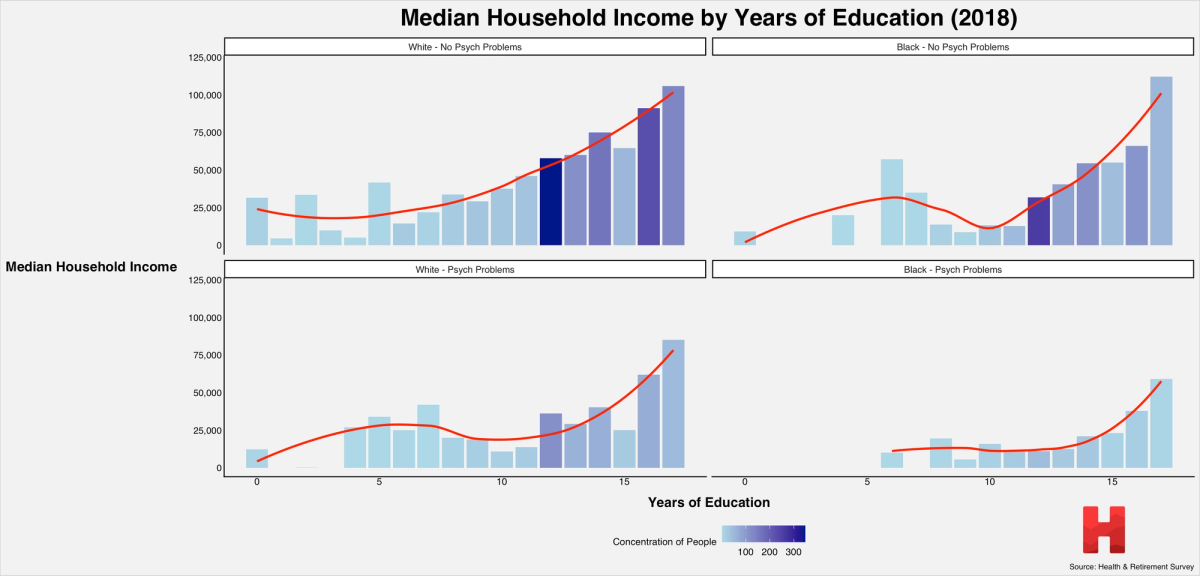 Median Household Income by Years of Education (2018)
Median Household Income by Years of Education (2020)
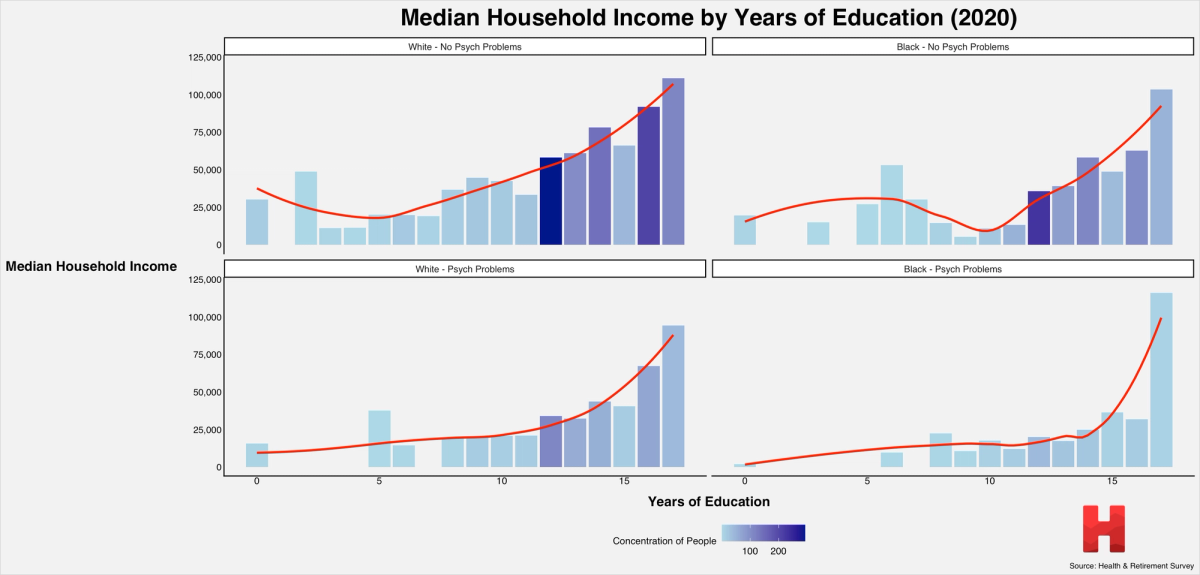 Median Household Income by Years of Education (2020)
From these visualizations, it is evident that years of education are a strong indicator of median household income. With more years of education, there is a higher median household income across all groups of people considered within this analysis. However, this effect seems to diminish when distinguishing between White and Black respondents, where Black respondents see a diminishing effect of years of education on median household income. Reported psychological disorders also showed a distinct negative impact on median household income. I proved this through a linear model with median household income as the dependent variable and three independent variables of years of education, race, and psychological disorders. This linear model showed very statistically significant positive effects of years of education on median household income, and statistically significant negative effects of race and psychological problems on median household income, as shown below:
────────────────────────
Overall Model:
F(3, 2738) = 144.3, p < .001
Predictors:
Education: t(2738) = 16.641, p < .001
Race: t(2738) = -7.364, p < .001
Psych problems: t(2738) = -7.249, p < .001
────────────────────────
Overall Model:
F(3, 2734) = 156.8, p < .001
Predictors:
Education: t(2734) = 18.069, p < .001
Race: t(2734) = -6.794, p < .001
Psych problems: t(2734) = -7.420, p < .001
────────────────────────
The model showed race has a statistically significant negative effect on median household income; when survey respondents are Black, it is associated with a lower median household income. The same also applies to reported psychological problems; when respondents report psychological problems, there is an associated lower median household income. These findings suggest systemic barriers such as racial inequality and the stigma surrounding mental health continue to have an impact on income.
Sources:
https://hu-my.sharepoint.com/:x:/g/personal/matthew_nock_college_harvard_edu/IQD08Zxl57VlRprUqJ6icw4uAXHpSspUsULDw5XO7HPt4fY?e=E9pHEI
https://journalistsresource.org/wp-content/uploads/2022/05/brain-g63f0dd283_1920.jpg